From an hour-long application to a recommendation that explains itself
How I helped move Multiverse's core business onto its product, and designed the learner journey that now matches thousands of people to the right apprenticeship.
- Company
- Multiverse (edtech)
- Role
- Senior Product Designer, design owner
- When
- 2024 to 2026
- Scope
- Learner journey (responsive web) and customer experience, across three squads
- 1.4% to 100%of bookings running through the product, April 2025 to June 2026
- 93%of learners commit to the programme we recommend
- 97.8%three-month retention for the first full cohorts, the best on record
Multiverse places apprentices inside employers, funded through the UK apprenticeship levy. In 2024 that business ran on manual handoffs. Applying took an hour or more, eligibility and motivation were checked by people, and only a quarter of customers ever sent their staff a skills survey. Separately, the company was testing a software product in the US that diagnosed a team's skills gaps and prescribed learning.
Working with the VP Product and Product Director, I co-created the vision to bring the two together: Funded Learning as a Service (FLaaSh), running the levy business on the same product, across three moments: diagnose, prescribe and treat. In August 2024 it was aligned with the exec team, and it became the foundation for a new product group. It was the company's first real move to running the core business on its product, beyond a contained experiment, so we worked hand in hand with sales and operations, took feedback at every launch, and kept iterating both the product and the internal processes around it.
My role: design owner for the first levy version (Diagnose for Levy), then for the learner Skills Scan through every change of ownership, and customer experience lead until September 2026. For long stretches I was the only designer across the top and middle of the funnel, working across three squads.
The vision replaced the hour-long application with one Skills Scan of about 15 minutes, covering eligibility, role fit, prior learning and motivation, with programme recommendations at the end. The first levy version proved the idea in a quarter: 71% of prospects started the scan and 91% finished it.
Then we hit the catch. A shorter application meant less commitment. Learners took the scan as cold prospects, often because their employer asked them to, and it was their leader who chose the programme, not them. As one colleague put it: "we don't have as much confidence in the intention of learners."
The design problem became: how do you keep the speed of a short scan while making sure the people who finish it actually want, and are suited to, the programme they're placed on?
Decision 1: Ask for commitment plainly
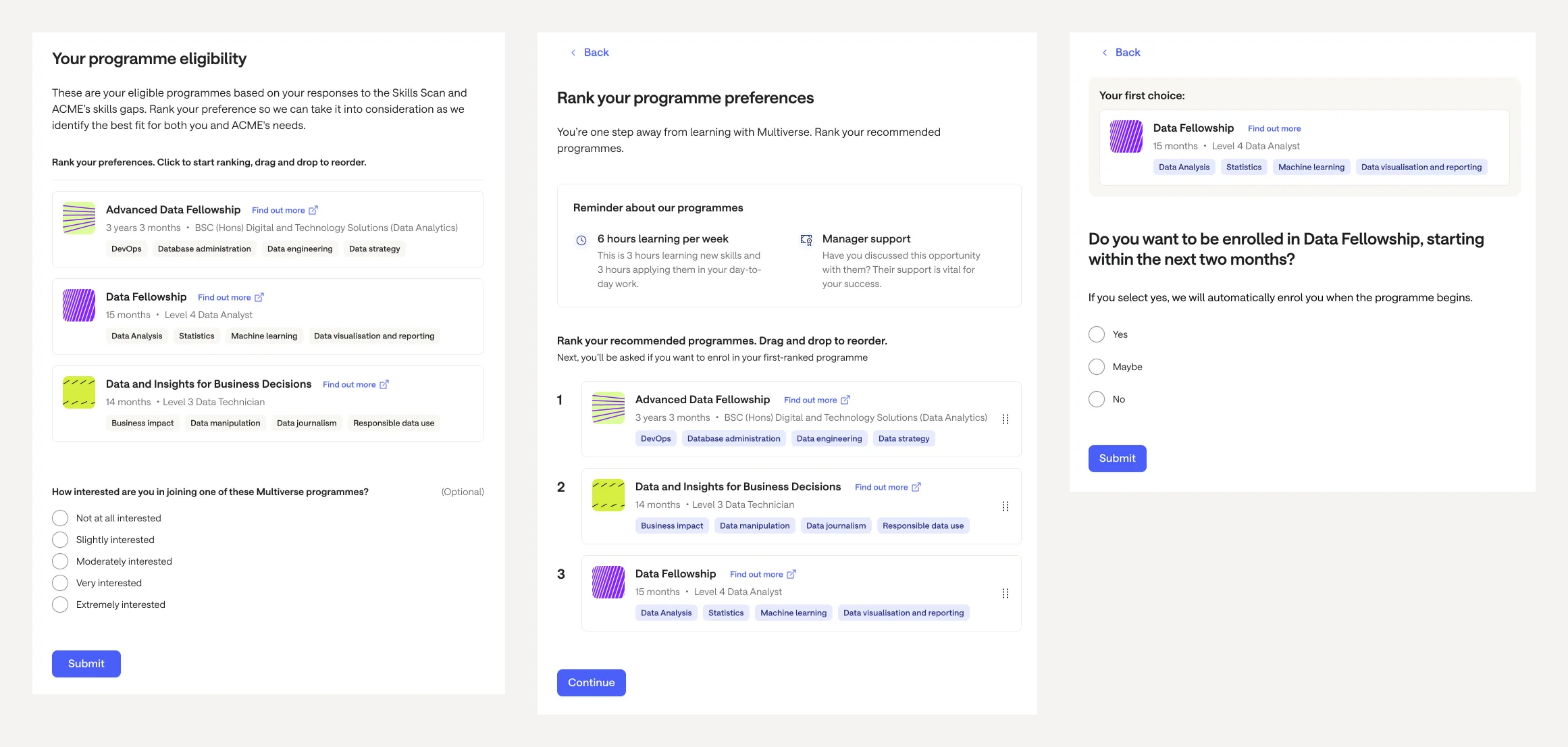
I designed a commitment moment at the end of the scan. The first version asked learners to rate their interest on a sentiment scale across a range of programmes. Internal teams couldn't interpret the answers, and the feedback exposed a deeper flaw: we were asking people to commit to programmes they knew nothing about.
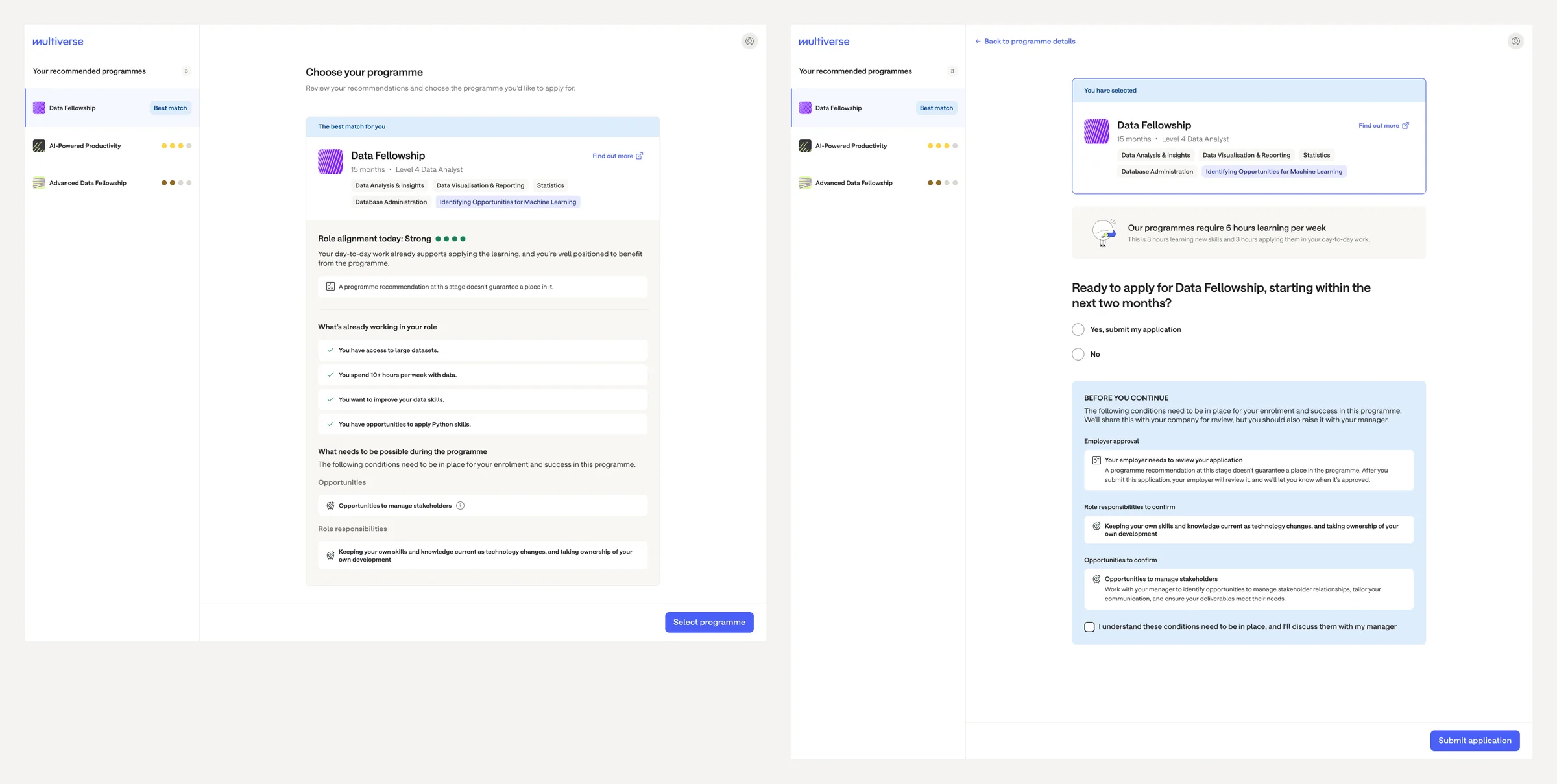
I used that feedback to get the sales team's buy-in for a clearer design: learners rank their recommended programmes, then answer one direct question, whether they'll enrol in their first choice, with Yes, Maybe or No, and a reason if it isn't Yes. When an early ranking pattern confused learners, I replaced it with a familiar drag-and-drop. By August 2025, ranking and commitment were split across two pages to make each decision lighter.
Decision 2: Fix the funnel one question at a time
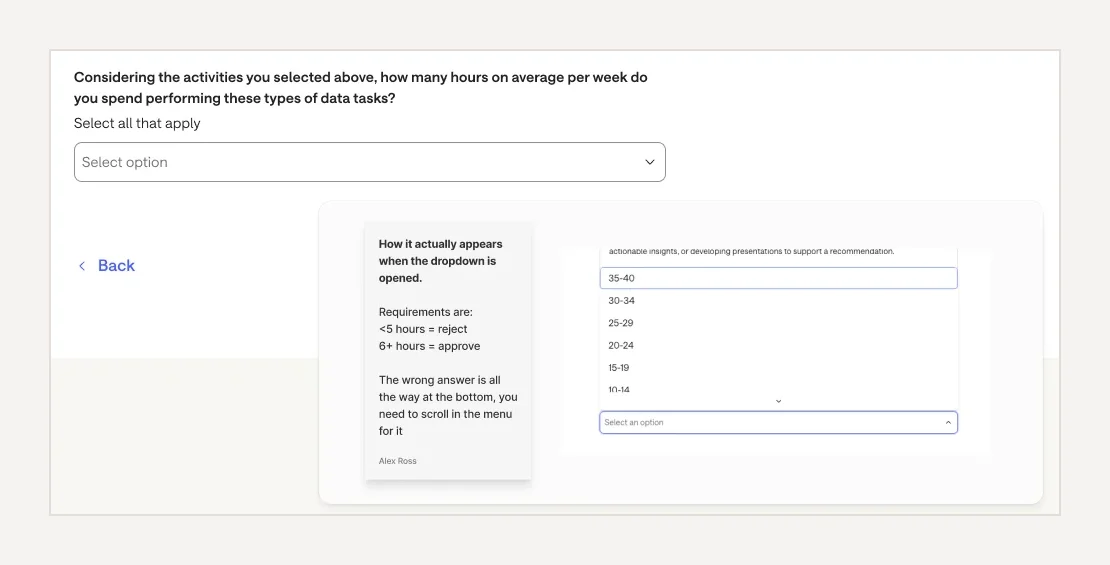
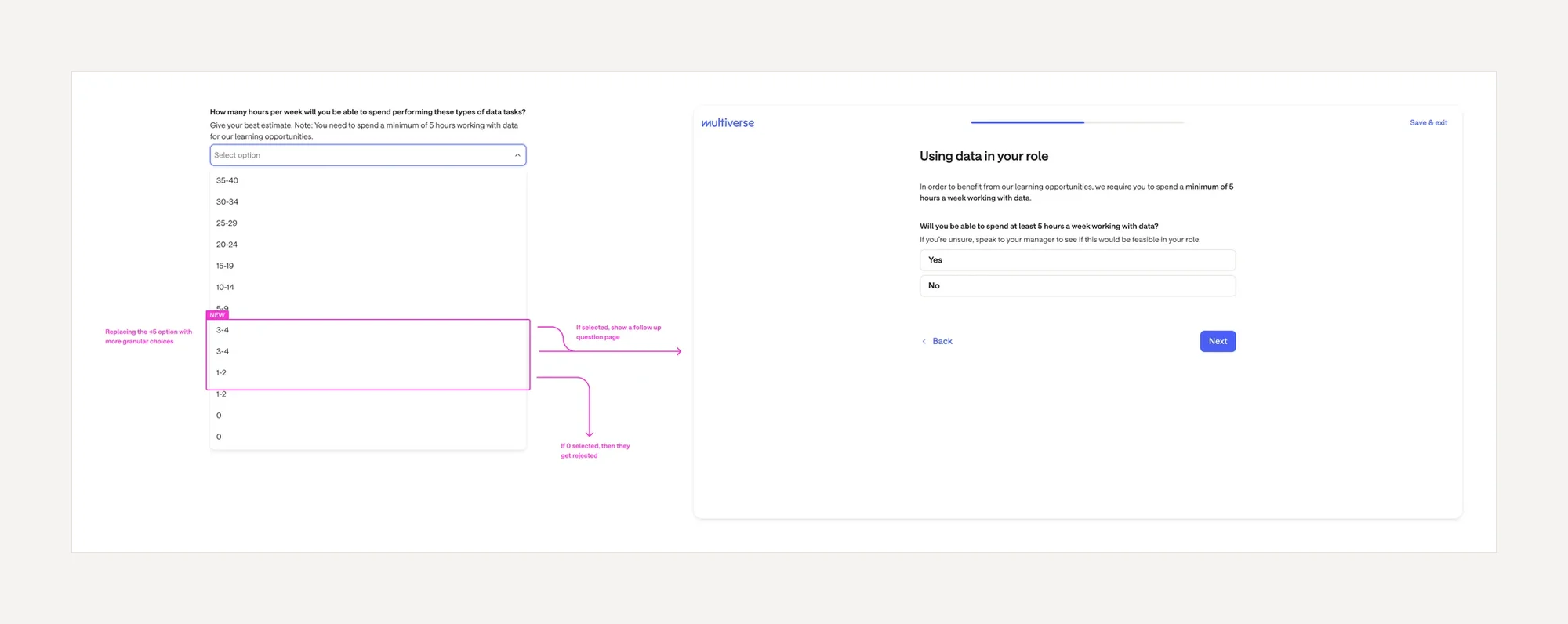
The scan was fast but it wasn't fair. In the pilot, 69% of applicants were auto-rejected, against 4% in the old process, so people who should have qualified were turned away. With our learning and workforce partners, I worked through the scan question by question:
- The hours question. A rule that rejected anyone working "fewer than 5 hours" on relevant tasks caused most of the rejections. We split it into smaller bands and reworded it to look forward ("Will you…").
- Role-fit language. We audited every role-fit question and answer, and wrote a set of rules that all new questions now follow.
- Recommendations straight after the scan, so learners see where they fit immediately rather than waiting for sign-off.
- Branching, to skip follow-up questions when a learner has no knowledge of a skill.
- Operations questions moved into the scan, such as date of birth and duties, so staff stopped chasing them by hand.
Decision 3: Make the recommendation explain itself
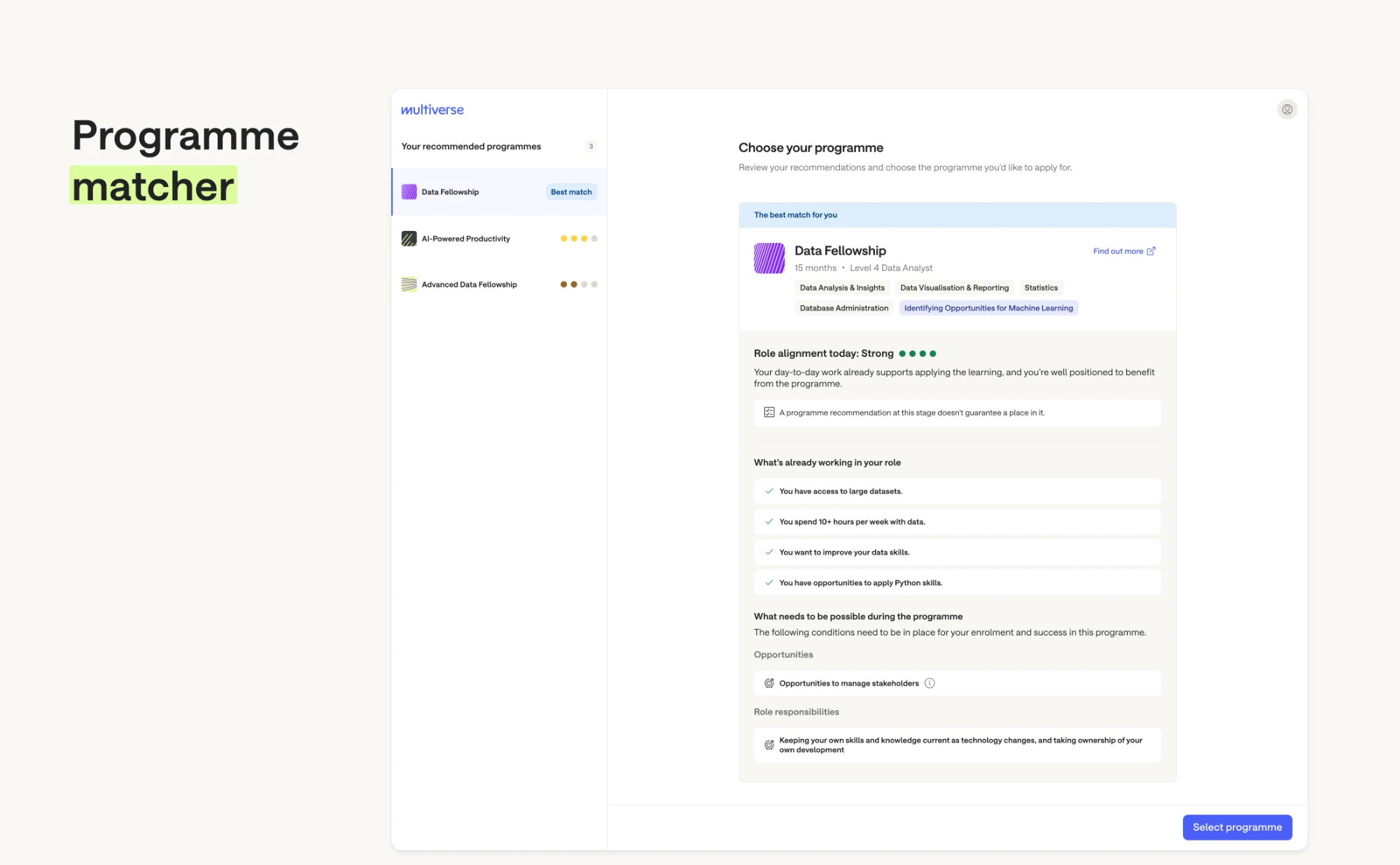
The last step was trust. Customers pushed back when a recommendation felt like a black box. One wanted their staff on a specific programme that the scan didn't recommend, and nothing on screen explained why.
The Skills Scan became Programme Matcher. Instead of three steps and a yes or no eligibility result, learners see ranked matches, a Best match badge and how their role aligns with each programme. Customers see the same reasoning: for every programme an employee scanned for, why they're a strong, good or limited match.
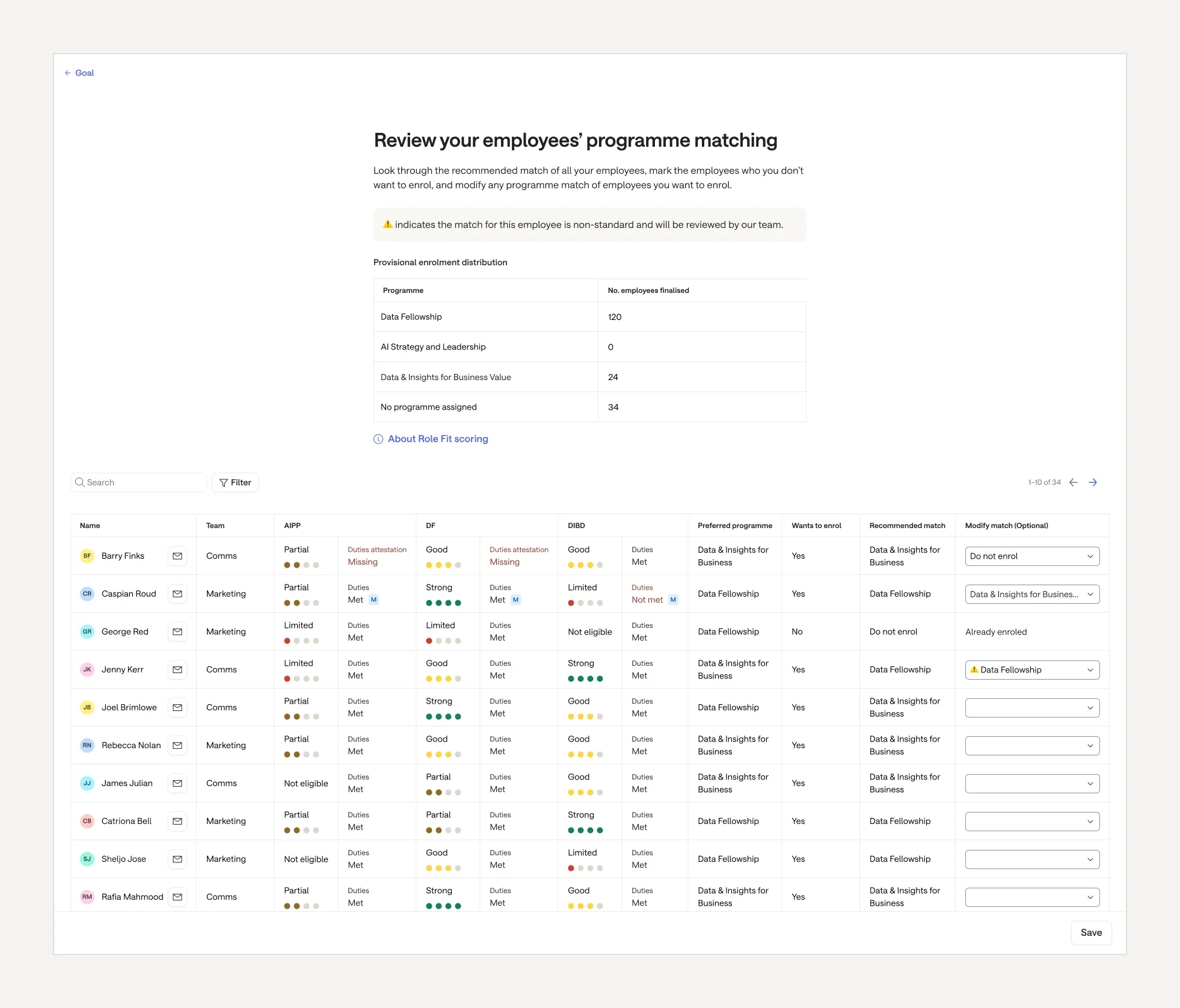
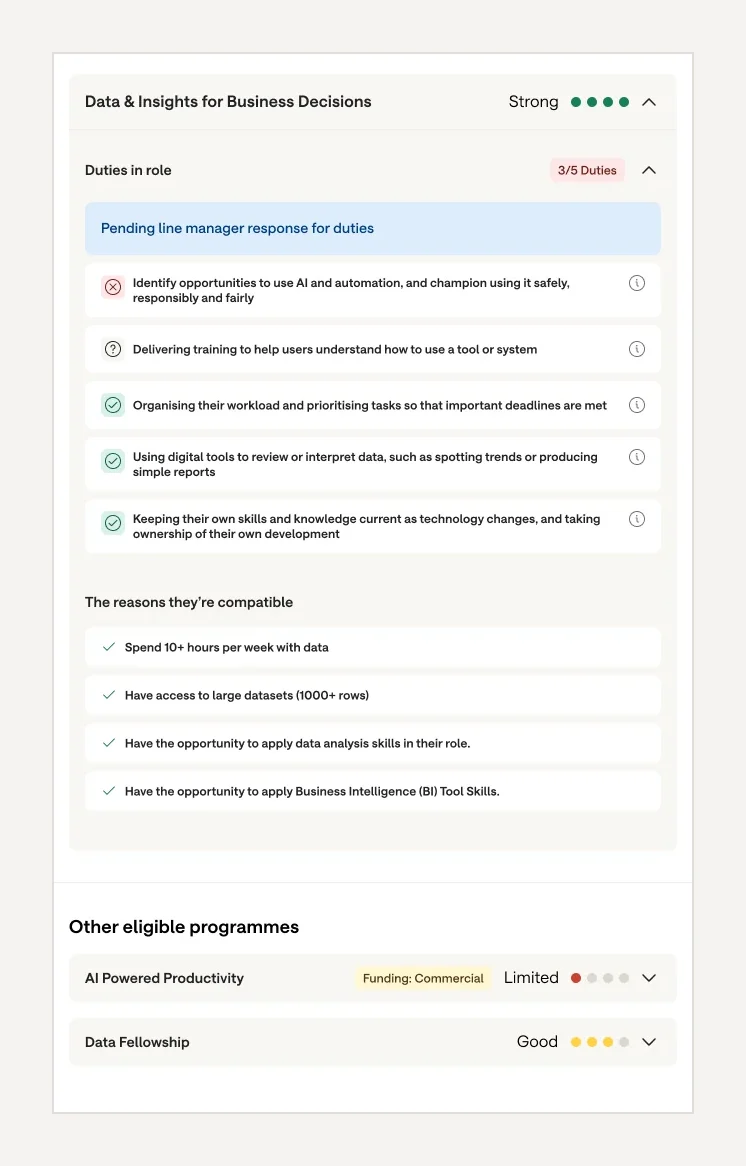
After we added "Map your day-to-day", a step where learners describe their role, duties confirmation rose from 23% to 61% in two weeks.
The 2025 pilots missed most of their targets. Learners rated the new scan 2.4 out of 5, against 4.1 for the application it replaced. Only 35% were approved, against a 75% target. The product was faster, but it wasn't yet fairer.
In October 2025 we stopped adding new deals for a quarter. Earlier that year I'd written up three possible ways to run the product, and the reset settled on one of them. We relaunched with the technical fixes the platform needed alongside the funnel and commitment changes above. Then, at our largest launch in February 2026, fewer than 200 people using the scan at once caused it to time out, and it took six days to resolve.
Both setbacks came from scaling ahead of the platform. They're also why the later numbers mean something: the relaunch was built on fixing what the pilots exposed.
By June 2026, every long-form programme ran through the product, up from 1.4% of bookings in April 2025. In the first full quarter:
| Measure | Result |
|---|---|
| Learners committing to the recommended programme | 93% |
| Three-month retention, first full cohorts | 97.8%, the best on record |
| Learners needing follow-up after applying | 13% to 2% |
| Programmes available through the product | 7 to 14, against a target of half |
| Fulfilment effort compared with the old process | 0.9x |
The relaunch quarter beat its targets: 31 deals against 25, and 1,619 learners committed against 1,000. At our largest launch, 508 learners enrolled against a target of 231, despite the outage. Sales leaders described it as "the deal which would never be possible without the product."
One gap remains: customer satisfaction is 67%, below the 76% baseline.
Since August 2026 I've been design lead on the next version, rebuilding the prescribe step as an AI-driven, conversational experience. My early prototype drove two decisions at Tech Leadership: sensitive personal data is captured by a structured form rather than passed through the AI agent, and design effort goes first into explaining the programme recommendation so learners can trust it, the lesson Programme Matcher taught us.
- Treat the emails as the product. Many complaints came from messages sent at the wrong moment, not from the screens. I'd design the comms alongside the flows from day one.
- Push harder on the platform before scaling. I'd argue earlier for load and reliability work, rather than finding the limits at our largest launch.